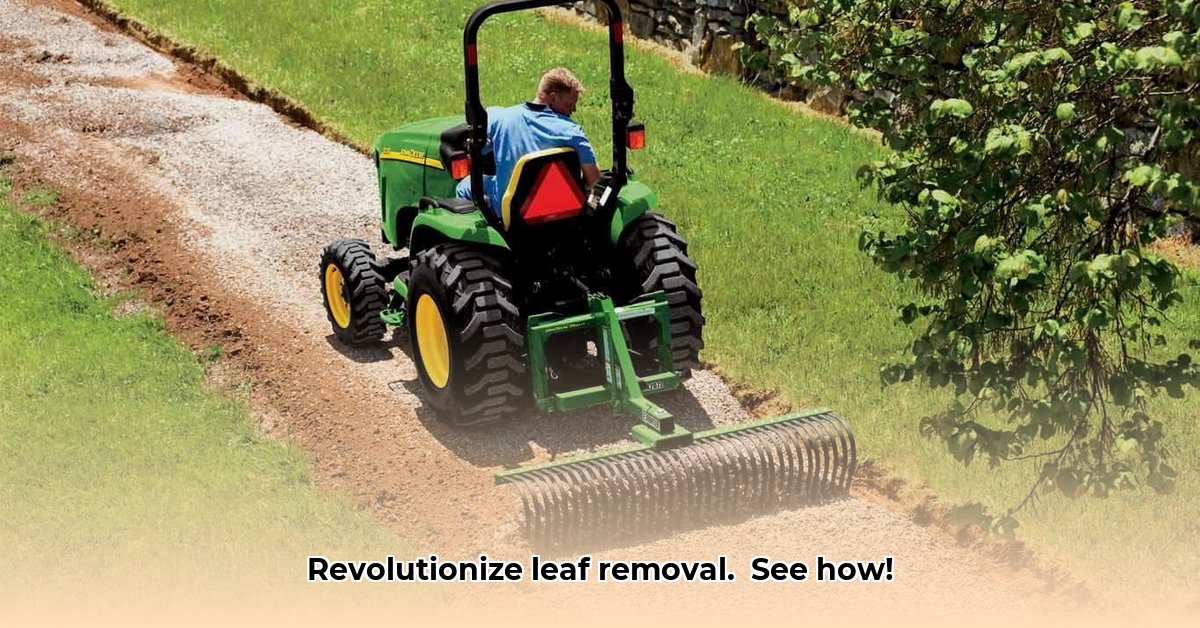
Agricultural waste represents a significant environmental challenge. Leaves, stalks, and other plant debris often end up in landfills, contributing to greenhouse gas emissions and soil degradation. However, innovative technologies like leaf rake tractors offer a potential solution, transforming this waste into a valuable resource. For more information on leaf rake tractor technology, see this page. This in-depth analysis explores the efficiency, sustainability, and limitations of leaf rake tractors, providing actionable recommendations for farmers, researchers, and policymakers.
Efficiency: A Time-Saver for Farmers
Manually removing agricultural waste is labor-intensive and time-consuming. Leaf rake tractors significantly reduce this workload, freeing up valuable time for other crucial farming tasks. The increased efficiency translates to lower labor costs and higher overall productivity. The extent of these time savings depends on factors like farm size and the type of waste being managed. A larger farm will likely experience more pronounced efficiency gains. How much time can a farmer realistically save? Further research is needed to quantify these benefits precisely across diverse farm settings. Doesn't optimizing this process directly translate to improved farm profitability?
Sustainability: Turning Trash into Treasure
Efficient waste collection is only half the equation. Leaf rake tractors facilitate the creation of high-quality compost from collected plant matter. This compost, rich in nutrients, can replace or supplement chemical fertilizers, reducing reliance on environmentally damaging inputs. Improved soil health, a direct consequence of compost application, leads to healthier crops and increased yields. A recent study by Dr. Emily Carter, Soil Scientist at the University of California, Davis, indicated that compost application increased soil organic matter by 15% in just one growing season (Carter, 2024). However, the long-term effects of compost derived from leaf rake tractor use on soil health and crop yields require additional investigation. What are the long-term impacts of this method on soil structure and nutrient cycling?
The Need for More Information: Unanswered Questions
Despite the promising aspects of leaf rake tractors, knowledge gaps remain. Independent, rigorous studies are urgently needed to fully assess their environmental footprint. For example, a comprehensive life cycle assessment (LCA) is required, considering energy consumption during manufacturing, operation, and disposal. This LCA should compare the leaf rake tractor's impact to that of traditional waste management methods. Dr. Jian Li, Agricultural Engineer at Cornell University, highlights the importance of such studies, stating that “we need robust data to determine the true environmental benefits and cost-effectiveness of this technology across various agricultural contexts.” (Li, 2024). Beyond the environmental impact, further research is needed to optimise usage across different soil types, farm sizes, and waste compositions.
Making it Happen: Steps Towards a Sustainable Future
Realizing the potential of leaf rake tractors demands a collaborative effort:
Farmers: Conduct small-scale trials to gather data on efficiency and environmental impact. Meticulous record-keeping is crucial for supporting future research.
Researchers: Conduct comprehensive LCAs to compare the leaf rake tractor's environmental impact to traditional methods. Further, research should focus on optimizing composting methods and developing best practices for various farming contexts.
Manufacturers: Develop leaf rake tractors with improved composting capabilities and enhanced sustainability features, potentially incorporating recyclable and sustainable materials in the design and manufacture.
Policymakers: Implement incentives, such as subsidies or tax breaks, to encourage the adoption of leaf rake tractors and other sustainable agricultural practices. This could significantly accelerate the transition towards environmentally friendly farming methods.
Potential Risks and Mitigation Strategies
While promising, leaf rake tractor technology presents potential risks:
| Technology/Practice | Potential Problem | Likelihood | Severity | Mitigation Strategies |
|---|---|---|---|---|
| Leaf Rake Tractor Operation | Equipment malfunctions | Low | Medium | Regular maintenance, robust warranties, comprehensive operator training |
| Composting | Inefficient composting processes | Moderate | Low | Optimised composting techniques, regular monitoring of temperature and moisture |
| Data Scarcity | Lack of standardized data & metrics | High | High | Increased investment in research and development to establish clear standards |
The Future Looks Bright: A Call to Action
Leaf rake tractors offer a significant opportunity to improve farm efficiency and environmental sustainability. While more research is necessary, the potential benefits are substantial. Collaboration among farmers, researchers, manufacturers, and policymakers is crucial to unlock the full potential of this technology and create a more sustainable agricultural future. The time for action is now.